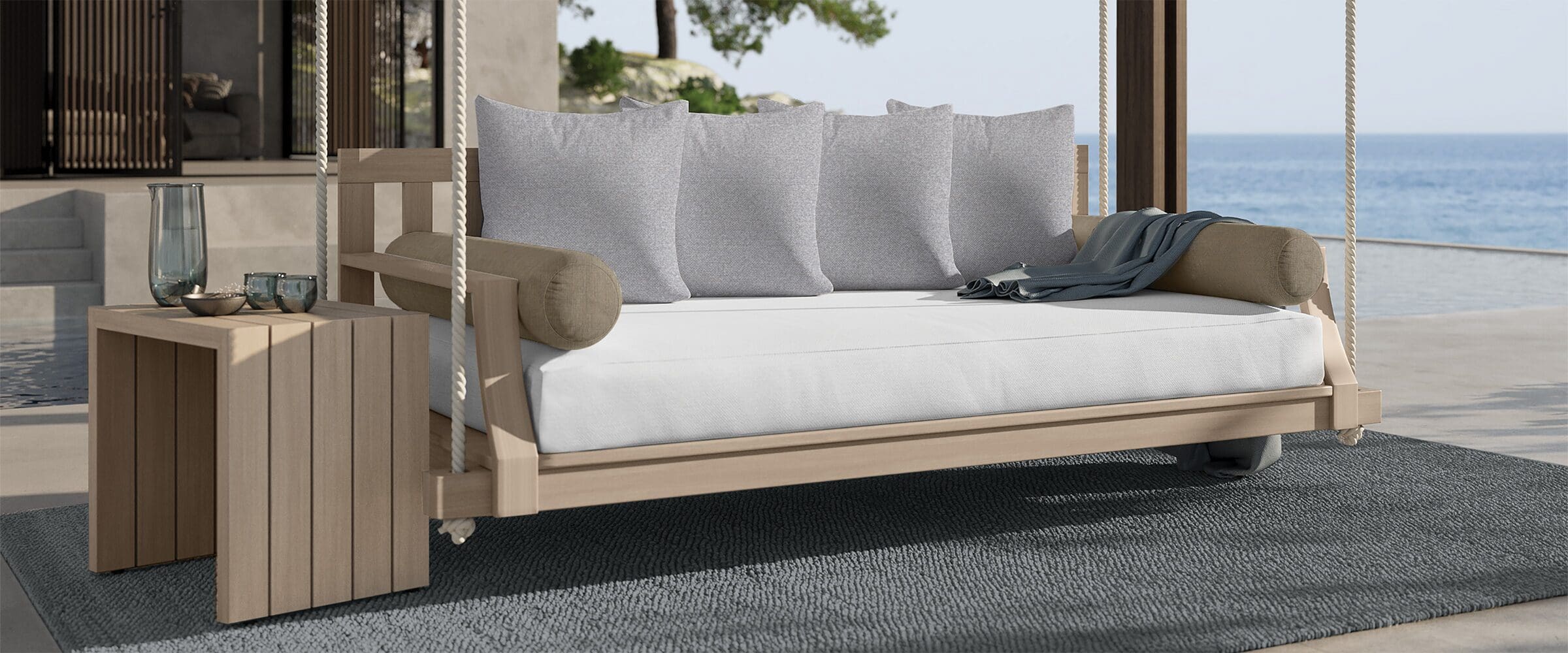
Forget sacrificing style for durability outdoors. These days, you can have those gorgeous linen and boucle looks on your patio thanks to amazing performance fabrics. The secret.. Solution-dyed materials like Acrylic (think soft, fade-resistant, and quick-drying) and Polypropylene/Olefin (super tough, lightweight, and budget-friendly). For sling chairs, PVC Coated Polyester is your go-to for strength, breathability, and quick drying. And when it comes to comfy cushions that won’t get soggy, always look for Reticulated Foam for its quick-draining, mold-resistant magic, often paired with Polyester Fiber for that extra plushness. Plus, keep an eye out for non-PFAS fabrics for a healthier choice! Keep reading to learn more about my top fabric choices for outdoor living spaces.
TOP FABRIC CHOICES
Who doesn’t love a good boucle or linen fabric on their sofa? But outside? Yes, you can have it! There are so many amazing performance fabrics on the market currently that not only last great outside, but look beautiful as well. Of course, you will want to consider the application of the fabric when choosing. For instance, a dark nubby fabric will show light-colored pet hair much more easily than a light-colored canvas. A more nubby texture may hold in debris, in which mold and mildew can grow. If you need a high level of shade from the sun, a 9 oz marine grade will allow much less sunlight through than a more porous weave. If used in a commercial setting, you will need to verify the abrasion rating.
Regardless of the or application or texture, any fabric that is going to last outside must be solution dyed. This is the process where the pigment is added to the polymer in its liquid state, then woven into fibers. Fabrics that have the color applied to the surface (such as polyester prints) are not suitable for extended outdoor use.
SOLUTION-DYED ACRYLIC
Originally developed in the 1940’s as an alternative to wool, acrylic (acrylonitrile) is a plastic which is very durable and resistant to the elements. It is inherently moisture-resistant and quick-drying, UV resistant, and shrink-resistant. It also has a soft texture, making it a great candidate for fabrics.
When I visited the Sunbrella factory, I was impressed with the entire process and the quality control that was evident. I watched as the pellets, which already had the color in them, had been heated and then made into fibers, which was then subsequently woven into fabric. High quality manufacturers will use UV stabilized pigments embedded into the fibers, which is a key element in the integrity of the fabric, and makes it very resistant to fading from the sun.
SOLUTION-DYED POLYPROPYLENE
Polypropylene (sometimes referred to as Olefin) is a durable, tough material which is abrasion resistant and used in many outdoor applications. Because of this, when solution-dyed, it is a great choice for outdoor fabrics, rope, carpets and other products. It is lightweight and cost-effective, and able to withstand fairly harsh weather conditions. However, it can become brittle and more susceptible to breaking down than acrylic fabrics.
PVC COATED POLYESTER
Sling is a popular choice for chair seats and backs and chaise lounges near pool and marine areas, resorts, restaurants, and other high-use areas. It is also used on the bottom of cushions to allow for drainage.
PVC coated polyester has a high tensile strength making it very strong and resistant to wear and tear. It can withstand the elements, chlorine and chemical exposure, is breathable, UV resistant, and won’t tear or crack. The fibers are coated and then woven together with perforations similar to wicker, allowing the sling material to be breathable, cool, and comfortable to sit on as well as water to flow through and dry quickly. It is a very popular choice when comfort is important, without the maintenance of cushions.
The weak point with sling furniture can be the connection point between the frame and sling material, so look for a well-constructed sling installation. Quality manufacturers will often use a double thickness of sling material and a rail or sleeve installation.
PFAS
Make sure that any fabrics purchased have a label identifying them as non-PFAS. Moving forward, any fabric being manufactured and sold after January 2025 must be non-PFAS. PFAS are a group of chemicals which are found in everyday applications such as food packaging and water-resistant clothing and are known for their oil repellency characteristics, and have been identified to pose potential health or environmental risks.
CUSHION FILL
Let’s face it…you can have a great quality sofa frame, but if your cushions fall flat, no one will want to sit on it. Fill is an integral component of the cushion. Here are the materials you need to know about:
RETICULATED FOAM
This makes up the “bones” of your cushion and provides structure and support. It’s important that the foam is reticulated, meaning it is open-cell as opposed to closed cell. Unlike standard foam, it has a “honeycomb” structure, which allows water to drain quickly and air to circulate. This makes it ideal for outdoor use, including rainy and humid climates. Inferior foam will hold water and allow mold to grow quickly. A high-density and high resilience commercial grade foam will be firm yet comfortable, quickly returning back to its original shape after being sat on.
POLYESTER FIBER
Also known as Dacron, polyester fiber batting is used in thinner set pads as fill, as well as wrapping around the foam inserts of larger cushions to soften and add cushioning. It is hypoallergenic, non-absorbent, and resistant to mold, mildew, and staining. This material will not hold its shape like foam, so it is most often used as the wrap for comfort purposes.
Ready to transform your outdoor space with beautiful, long-lasting fabrics and cushions? You’ve learned about the best materials for durability, comfort, and style. Apply this knowledge to choose the perfect outdoor fabrics and cushion fills for your home and enjoy your refreshed patio or garden oasis! For more information or help designing the perfect space, reach out today.

Be The First To Comment